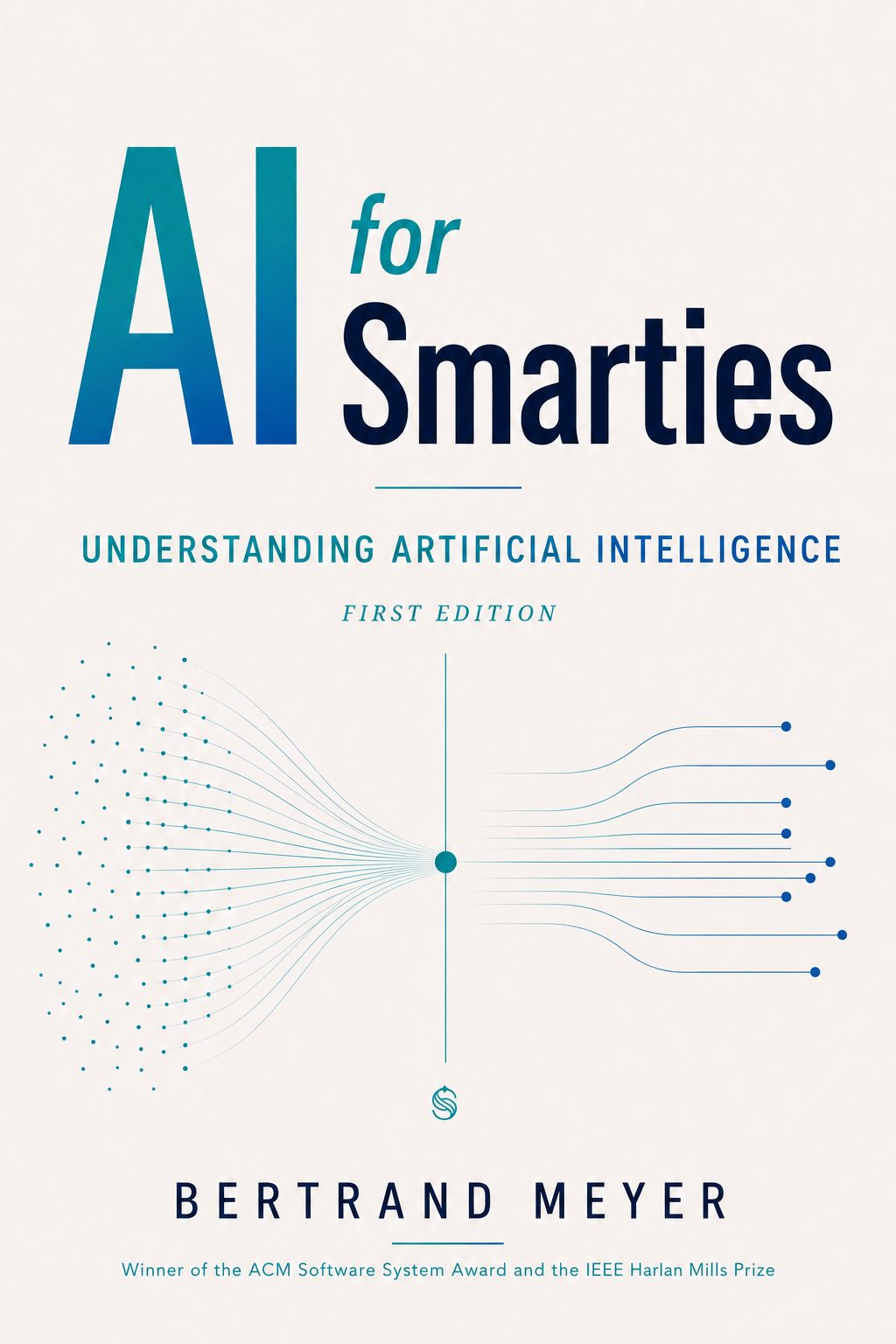
The most important technology of our time — decoded Millions use AI every day. Few understand why it works.

✓ Why large language models work ✓ Why learning replaced rules ✓ What AI means for software engineering, education, and society A clear explanation of AI from one of software engineering's pioneers, Bertrand Meyer. – Author of classic best-seller Object-Oriented Software Construction – ACM Software System Award – IEEE Harlan Mills Prize

Buy E-Book — €29.95 Get your personalized ebook
AI for Smarties: Understanding Artificial Intelligence
UNDERSTANDING AI

Praise from early reviewers

More praise

AI may be the most hyped technical topic ever, making it particularly urgent to cut through the noise and understand the good, the hype, and the ugly

Philippe Kahn Founder of Borland, Starfish, Lightsurf, inventor of the camera phone

In this impressive book, Bertrand Meyer delivers a masterclass on modern AI. He progressively guides the reader from foundational principles to advanced topics, seamlessly incorporating history, philosophy, societal implications, and key debates—all within a brilliantly engaging and accessible manuscript.

Lionel Briand Director Ireland's national research center for software research, pioneer in software testing and trustworthy AI

The book is a genuine work of demanding popularization, rooted in the tradition of le gai savoir, or perhaps in the best traditions of geek culture, where intellectual rigor is in no way incompatible with humor, curiosity, and the joy of sharing knowledge without pretension.

Stéphane Dalbera digital innovator, founder of Atopos

Clear and simple: your key to understanding why AI works

The path to Modern-AI

How the logic-based techniques of Old-AI failed and gave way to neural networks, backpropagation, gradient descent, and other techniques behind LLMs and other AI successes — explained simply and clearly.

How to use AI effectively

Modern-AI systems are impressive but imperfect. To use them effectively you must understand how they work. This books enables you to stay on top of AI and steer your career in an AI-rich world.

The risks and allure of AI

Dreams, Doubts and Dread — is AI the path to humanity's future, or a threat to the world? Go beyond the hype and vacuous claims; learn what AI really is and get it to work for you.

About the book

AI for Smarties Understanding Artificial Intelligence By Bertrand Meyer Published by Smarties Press, July 2026 272 + x pages 17 chapters + Bibliography, glossary, index Full color 82 figures, numerous other illustrations

You get more than a book

By purchasing a copy of AI for Smarties, you get access to many resources: exercises, weekly quizzes, reader forum*. Best of all, you get one year of free updates — a particularly important benefit for a technology which evolves so fast. *Reader forum available Aug. 1st

Explore the Table of Contents

Click on any chapter header to preview its content and learn about our structural software guidelines.

✓ The full table of contents ✓ The Preface ✓ Sample chapter: Education in the AI era ✓ Sample technical section: Softmax

Chapter 1: Dreams, doubts and dread +

This book is about enabling you to make sense of AI and rise above the clichés — amplified by the media and social networks — which encumber many people’s perceptions. To overcome them, we first have to name them. This chapter lists features of AI, real or imagined, in three categories: exciting possibilities about which you might have fantasized (“dreams”); qualifications and uncertainties (“doubts”); fears (“dread”). …

Chapter 2: Unscrambling two full examples +

We are just at the start and I have not introduced any theory whatsoever. Before we embark on any systematic exploration, I want to give you a first idea of how things work behind the scenes. It will not be a deep technical explanation, simply an informal introduction to the workflow; the techniques come in the following chapters. We are going to apply this exercise to two examples: one involving analyzing a text and answering a question about it; the other showcasing one of the biggest successes of Modern-AI, automatic translation of human languages.

Chapter 3: The triumph of experience +

Equipped with a first informal glimpse at how AI-based systems work, we embark, in this chapter and the next, on general principles which underlie the entire technology. The present chapter singles out one principle which you need to grasp if you are to understand everything else. It is a kind of meta-principle, refined by some of the more concrete principles of the next chapter. If you are new to Modern-AI technology, it will only sink in as you read the rest of this book. It is the most offensive and misunderstood feature of Modern-AI. It would not have been applicable 20 years ago, and it may not hold in its exact present form 20 years from now. But in today’s AI technology it influences everything. …

Chapter 4: The principles of Modern-AI +

Let not the words “Artificial Intelligence” fool you. Whether we judge it “intelligent” or not, today’s AI is the application of a specific set of technical mechanisms. This chapter explains the principles that underlie the whole approach. We already saw a “meta-principle”, Empiricism, in the previous chapter. As a preview, and roadmap for the present chapter, here are the other eight. …

Chapter 5: The path to Modern-AI: a brief history +

“Artificial Intelligence” today covers a specific range of techniques, reviewed in the rest of this book. They are not the first to have used the term, which dates back to 1955; they are in fact radically different from the techniques that were tried in the first decades of AI. To understand Modern-AI, it is essential to form a good picture of what came before.

Chapter 6: … But is it Intelligence? +

This book stays away from speculation and philosophy; it leaves it to others to expound on the deeper meaning of AI. Its goal is more pragmatic: to provide the essential knowledge enabling you to understand what Modern-AIreally is, under the hood. Only with this understanding can you see through the speeches (whether messianic or apocalyptic) and make up your own informed judgments. One abstract question, however, deserves our attention as our last preamble before we go into AI techniques: the notion of intelligence, the “I” in AI.

Chapter 7: Using a neural network +

We start our study of Modern-AI systems by taking a look at today’s dominant architecture: neural networks. Specifically, “Feed-Forward Neural Networks”. It will be an opportunity to familiarize ourselves with the basic terminology. If you have been terrified of words such as “neural” and “neuron”, you will discover that they actually cover simple and clear concepts. …

Chapter 8: The math you need +

“The math you need”. Do you need the math? Maybe you think “I can master the concepts without reading the formulas!”. Well, yes and no. True, lots of people pontificate about AI without having a clue. But, honestly — do you want to be like them? As the title of the book states, I want to you to understand AI. That requires understanding the basic math under it. …

Chapter 9: What a neural network computes +

I hope you took as much pleasure reading the preceding chapter about the necessary mathematical concepts as I had trying to make them as simple and clear as humanly possible, devoid of any unnecessary jargon or intimidation. Whether they were just a boring recap of things you knew since Kindergarten or before, a welcome refresher of stuff you vaguely remembered, or an obstacle course through which you had to struggle, the good news is that you now have what you need to understand the basics of Modern-AI systems. …

Chapter 10: Training a neural network +

A neural network is a machine to produce answers. We want these answers to be the right ones; more precisely, in Modern- AI’s statistical approach, they should be right as often as possible. In the previous chapter we saw how a neural network functions, computing at each layer a function of the form NL (W * X + B). Modern-AI builds the network through machine learning, using a process described in the present chapter. …

Chapter 11: From embeddings to transformers +

The previous chapters have given us the overall architecture of neural networks — as simple in its basic ideas as it is impressive. That technology is the basis for most Modern-AI systems but other ideas complement it and, in particular, underlie the amazing performance of Large Language Models. They are particularly relevant for systems (such as LLMs) which deal with human-language texts as their inputs and outputs. They include in particular the topics of this chapter: how to encode tokens into “embeddings” (as previewed in our early example chapter) and a gradation of techniques for handling the full scope of a possible complex input: from convolution, recurrent and “long-short-term memory” networks all the way to the technology that made LLM success possible: attention and transformers. …

Chapter 12: Using AI effectively +

With Modern-AI, we have incredibly powerful tools at our command. Powerful — and imperfect. How do we use them right, to our benefit (and without undue detriment to others’ benefits)? This chapter collects practical guidance, essential if you want to use AI as part of an effective solution rather than letting it create new problems.

Chapter 13: Risks of using AI +

Passion around AI runs both ways, for and against. Our goal here, beyond passions, is to understand the negatives (some already encountered when the previous chapter examined which applications do not easily lend themselves to AI). Knowing the risks is the first step towards mitigating them — when at all possible, which as we shall see is not always the case. …

Chapter 14: Socrates reborn: learning with AI +

A part of our review of applications of AI deserves special attention: using AI tools, specifically Large-Language Models, to help learning. I have singled out this topic into a chapter of its own since its objective is to give a piece of advice — both simple and important — on how best to take advantage of LLMs for personal learning. The question of using AI in educational environments is separate, and the topic of the next chapter (15, page 219). Here we examine self-learning for adults and professionals, not education in schools and universities. There is no suggestion that such a process, or AI tools, remove the need for a teacher in standard education. …

Chapter 15: Education in the era of AI +

No area of human activity may be more affected by Modern-AI than education. You hear enthusiastic predictions about how AI will revolutionize education, and doomsday assessments that it is killing education. In the general spirit of the rest of this book, this short chapter puts aside both the hype and the gloom and tries to derive some practical lessons. Often it seems that he enthusiasm comes from AI experts and others outside the educational system, and the doom from educators. Curious, is it not? …

Chapter 16: What happens to software development? +

AI is a product of software development; in turn, software development is one of the areas most spectacularly affected by the development of Modern-AI. “Affected” is a mild way of putting it: over just about a year (2023), AI tools revolutionized the practice of programming, leading to a form of development for which one of its promoters, Andrej Karpathy— in a 2025 post on X (Twitter) Karpathy 2025 — introduced a catchy name: vibe coding. Many people go further, stating that the world no longer needs programmers, the profession being doomed to follow the fate of horse-drawn carriage drivers and, more recently, draftsmen (experts at technical drawing), whose great skills were rendered obsolete by the appearance of the AutoCAD drafting software in the1980s. This chapter assesses the state of the art of applying AI to software development and the challenges ahead. …

Chapter 17: How to make AI work for you +

The AI wave is not a passing fad. It may not be the messianic or apocalyptic event that its most extreme promoters and adversaries picture, but it is having a profound effect on the world, which will intensify as the technology develops in the coming years. This book has given you a solid handle on what it is about: its technical features, its benefits, its limits, its risks. We conclude our review with a few notes on how to adapt everyone’s personal career strategy to this radical innovation. …

AI for Smarties: Understanding Artificial Intelligence €29.95
Buy E-Book